Salesianos Los Boscos has presented the final results of VitiSensor, an innovation project developed by students from Telecommunications vocational training programmes that has enabled the design, construction and implementation of a modular sensor system for smart vineyard monitoring.

The initiative, selected in the 9th Dualiza Grants Call, promoted by CaixaBank Dualiza and FPEmpresa, demonstrates how Vocational Education and Training can generate real technological solutions to address the challenges faced by strategic sectors such as the wine industry.

During the project, students developed an IoT system based on LoRaWAN communications, consisting of a central module and several peripheral modules capable of measuring agroclimatic and physiological variables in the vineyard. The collected information is transmitted in real time to a monitoring platform where the data can be viewed, stored and analysed to support decision-making in crop management.

As a result, the first VitiSensor system has already been installed in a vineyard in La Rioja, and four new agreements have been reached for future implementations, confirming the interest this technology has generated within the agricultural sector.

Open technology at the service of the vineyard

One of the project’s most notable achievements has been the launch of the VitiSensor Site, a web platform created to facilitate knowledge transfer and the replication of the initiative. It provides other educational institutions, teachers, students and professionals with access to all the technical documentation developed during the project.

The site includes information on the components used, electronic schematics, source code, 3D printing designs, IoT platform configuration, examples of data visualisation and teaching materials. In this way, VitiSensor goes beyond the boundaries of the school itself and becomes an open resource for promoting new innovation experiences.

In addition to its technological outcomes, the project has had a significant educational and dissemination impact. A total of 28 students took part directly in its development through Project-Based Learning (PBL) methodologies, working alongside companies and partner organisations in a real innovation environment. Around 150 additional participants were also reached indirectly through the dissemination activities carried out.

Throughout the project, two technical training sessions, six presentation events, workshops and talks were organised, as well as a technical visit to Finca La Grajera, run by the Institute of Grapevine and Wine Sciences (ICVV), and a demonstration session for farmers held at Bodegas Ondalán. More than 50 publications were also produced across media outlets, websites and social media.

During the final presentation, a live demonstration of the system was carried out, showing the complete process from data collection by the sensors to its transmission via LoRaWAN and its visualisation on the platform developed.

  • The call will provide €511,839 to support the development of 40 VET projects, the highest amount in its ten editions.
  • The projects will involve 2,541 students, 264 teachers and 70 partner organisations, with 68 VET institutions receiving financial support.
  • Artificial intelligence, drones, accessibility, the circular economy, smart industry and sustainability are among the main trends in this edition.

The 10th Dualiza Grants Call, promoted by CaixaBank Dualiza and the Association of Vocational Education and Training Centres FPEmpresa, with the collaboration of Fundación Deloitte, has selected the 40 most innovative VET projects in Spain, which will receive financial support for their development during the 2026–2027 academic year. This edition has once again broken records in both participation and funding, exceeding half a million euros allocated to project support for the first time and becoming the most ambitious edition in the programme’s history.

The full list of selected projects is available at www.caixabankdualiza.es.

The projects are led by 40 coordinating institutions, together with a further 28 participating institutions, bringing the total number of Vocational Education and Training institutions receiving financial support to 68, ten more than in the previous academic year. Altogether, the selected initiatives involve 2,541 students, including 299 enrolled in Intensive Dual VET, and 264 teachers, reinforcing the role of Vocational Education and Training as a driver of applied innovation and as a source of solutions to the challenges faced by productive sectors.

Trends: AI, smart industry, sustainability, accessibility and new circular economy solutions

Thematic diversity is once again one of the most notable features of the call. The selected projects show how Vocational Education and Training is incorporating emerging technologies and developing applied solutions to address challenges related to the green transition, digital transformation, accessibility and the improvement of production processes.

Artificial Intelligence applied to industry, health and accessibility

AI is playing an increasingly prominent role in this edition. The selected projects include industrial quality control systems using computer vision and 5G, platforms to support the interpretation of clinical analyses, tools to adapt administrative documentation into accessible formats, and intelligent voice solutions designed to improve digital accessibility. Other noteworthy initiatives combine AI with IoT, predictive modelling or digital twins to optimise production and construction processes.

Industry 5.0, automation and digital twins

The digital transformation of industrial environments is present in numerous projects. These include autonomous infrastructure inspection systems using mobile robotics, digital twin-based learning environments, smart inventory management systems using RFID, connectivity platforms for emergencies powered by renewable energy, and advanced solutions for digitising manufacturing and quality control processes.

Sustainability, circular economy and new materials

Sustainability continues to consolidate its position as one of the main areas of work. The selected projects include the development of construction materials made from waste, bio-resins produced from renewable raw materials, systems for compacting and reusing industrial waste, biodegradable substrates for hydroponic crops, and new applications aimed at making use of agricultural and food by-products. There are also initiatives focused on transforming agricultural surpluses into new value-added food products.

Environment, biodiversity and smart monitoring

Another major trend is the use of technology to understand and protect the environment. The projects range from environmental monitoring and water quality control systems to ecological restoration initiatives, soil health monitoring, green infrastructure for sustainable water management and atmospheric analysis platforms for assessing environmental impacts.

Drones and new observation technologies

Drones continue to gain prominence as both an educational and technological tool. The selected initiatives include developments related to environmental restoration through aerial seeding, devices designed to facilitate safe take-off and landing operations, and systems for capturing and analysing environmental data using instrumented aerial platforms.

Health, well-being and assistive technology

The call also includes projects focused on healthcare and social care, with initiatives centred on the development of clinical simulators, devices for monitoring physiological parameters, applied research into biomarkers and gut microbiota, and personalised orthopaedic solutions manufactured using 3D printing technologies.

Overall, the selected projects cover a broad range of vocational fields, with particular prominence given to Electricity and Electronics, Information Technology and Communications, Mechanical Manufacturing, Agriculture, Sociocultural and Community Services, and Healthcare, reflecting the growing connection between Vocational Education and Training, technological innovation and the sustainability challenges faced by companies and public administrations.

Among the 40 selected projects, 11 are collaborative network initiatives, which together receive €247,200 in funding and continue to strengthen cooperation between educational institutions in order to develop shared solutions to common challenges. The projects also involve 70 partner organisations, including companies, associations, public administrations and social organisations. In fact, more than 10% of the selected projects stem from a specific need identified by a company.

In selecting the projects, the evaluation committee placed particular emphasis on the innovative and applicable nature of the proposals, their transferability, the diversity of stakeholders involved and their social impact. The long-term sustainability of the initiatives, the quality of their work plans and their contribution to the Sustainable Development Goals were also taken into account.

In this context, Paula San Luis, Director of CaixaBank Dualiza, highlighted “the growing importance of the call as a tool for supporting teachers and educational institutions; an importance reflected in the fact that one in ten VET institutions across Spain has submitted a project to take part, and that a large proportion of these projects respond directly to the needs of companies”.

For his part, Luis García, President of FPEmpresa, stressed that this tenth edition once again demonstrates that “VET institutions are spaces for talent, innovation and responses to the challenges of their surroundings. Through this call, we want to continue supporting them so that their ideas can become real projects with an impact on students and the productive sector”.

The Dualiza Grants Call is therefore consolidating its position as one of the main drivers of support for innovation in Spanish Vocational Education and Training. Over its ten editions, it has promoted more than 340 educational initiatives and has already distributed close to €4 million to support projects developed by VET institutions across the country.

FPEmpresa took part in the presentation of the study “The Vocational Education and Training System and Innovation in Spain”, a research project promoted by Fundación CaixaBank Dualiza and Fundación Cotec for Innovation that analyses the role of VET as an innovation agent, its contribution to the productive and social fabric, and the challenges that remain in achieving greater recognition within Spain’s R&D&I system.

The event was held on 2 July 2026 at CaixaBank All in One Plaza de Colón in Madrid and brought together more than 100 representatives from companies, public administrations and educational institutions. Representing FPEmpresa was Sergio San Martín, Secretary of the Association and Director of Innovation at Centro de Formación Somorrostro, who took part in a round table focused on how Vocational Education and Training drives innovation through educational institutions, companies and local territories.

FPEmpresa’s participation in the event reinforces the Association’s commitment to raising the profile of VET as a key player in applied innovation. FPEmpresa also contributed to the development of the study, which was based on a survey of 258 Vocational Education and Training institutions across Spain, together with 29 in-depth interviews, four focus groups and an analysis of more than 50 scientific publications.

The report shows that Vocational Education and Training has been contributing to innovation in companies, particularly SMEs, for decades through knowledge transfer, the development of applied solutions and the incorporation of skilled talent. However, it also points out that this contribution continues to receive limited recognition within R&D&I policies and structures.

VET innovation driven by schools, companies and local communities

The event opened with contributions from Tomás Muniesa, Chairman of Fundación CaixaBank Dualiza and CaixaBank, and Cristina Garmendia, President of Fundación Cotec for Innovation, who highlighted the need to recognise the role of Vocational Education and Training within the innovation system.

During the event, Mónica Moso, Head of the Knowledge and Innovation Centre at Fundación CaixaBank Dualiza, and Ainara Zubillaga, Director of Education at Fundación Cotec, presented the study’s main conclusions. This was followed by a round table moderated by Miguel Massigoge Galbis, CEO of Possible Lab, featuring Sergio San Martín, representing FPEmpresa; Juan Campaño, from O Forno Garden; and María Elena Sanz Ibarra, Director General of People, Organisation and Culture at Atlantic Copper.

The study highlights that innovation in VET institutions often stems from the leadership of management teams, the commitment of teachers and the experience accumulated through previous projects. It also points out that innovation is more effective when it is no longer treated as an isolated activity and instead becomes integrated into the institution’s strategy through defined plans, long-term projects and specific coordination roles.

Another key aspect highlighted in the report is the direct connection between Vocational Education and Training and the productive sector. Dual VET, collaborative projects, work-based learning and cooperation programmes with companies allow the knowledge generated in educational institutions to be applied directly to production processes. In this context, VET students and graduates become a key channel for introducing up-to-date technical knowledge, identifying inefficiencies and proposing organisational and technological improvements.

The report also sets out a roadmap to strengthen the role of Vocational Education and Training within the innovation system. Its main proposals include formally recognising VET as an actor within the R&D&I system, developing strategic innovation plans, ensuring stable funding, evaluating results and increasing the participation of VET institutions in decision-making and governance structures.

The event concluded with contributions from Esther Monterrubio, Secretary General for Vocational Education and Training at the Ministry of Education, Vocational Training and Sports, and Juan Cruz Cigudosa, Secretary of State for Science, Innovation and Universities, who highlighted the strategic role of VET within the R&D&I system.

  • 560 Vocational Education and Training centres have taken part in this edition, leading 357 innovative initiatives in collaboration with 729 entities
  • Andalusia, the Valencian Community and the Canary Islands are among the regions with the highest number of projects submitted
  • The call consolidates its role as a driver of innovation, collaboration and transfer in VET

The Dualiza Call for Proposals, promoted by CaixaBank Dualiza and FPEmpresa in collaboration with Fundación Deloitte, has once again reached a milestone in its trajectory after recording record participation figures in its tenth edition. A total of 560 Vocational Education and Training centres, out of the 4,099 across Spain, have submitted projects, 91% more than in the previous edition. This means that one in ten centres in the country has submitted initiatives to take part in this call, aimed at promoting educational innovation and collaboration with the productive sector.

In total, 357 projects led by VET centres have been submitted, with the involvement of 729 collaborating entities — including companies, public administrations, universities and technology centres — reinforcing the collaborative nature of the call as a key element in bringing training closer to the real needs of the labour market.

Strong presence of collaborative and networked projects

Of the projects submitted, 261 correspond to local initiatives, while 96 have been developed in networks between centres from different autonomous communities, a modality that continues to gain importance by fostering interterritorial cooperation and knowledge exchange.

By type of centre, participation is once again led mainly by public centres (286), followed by state-funded private centres (56) and private centres (15), reflecting the reach of the call within the Vocational Education and Training system.

Presence across the whole country

The call has recorded participation in almost the entire national territory. The autonomous communities with the highest number of projects submitted were the Valencian Community (41), the Canary Islands (39) and Catalonia (39), followed by Andalusia (35), Castilla-La Mancha (30), the Community of Madrid (29) and the Basque Country (28).

This territorial reach highlights the consolidation of the Dualiza Call for Proposals as a key tool for promoting educational innovation projects adapted to the needs of each environment.

What is the Dualiza Call for Proposals?

The Dualiza Call for Proposals is an initiative promoted by CaixaBank Dualiza and the Association of Vocational Education and Training Centres FPEmpresa, in collaboration with Fundación Deloitte, to fund and promote innovative Vocational Education and Training projects developed in collaboration between educational centres and companies or other entities.

Its aim is to promote real collaboration between VET centres and the business sector, encouraging work-based learning, educational innovation and knowledge transfer.

Next steps

Following the closure of the application period, the projects will be assessed by a specialised committee, which will analyse aspects such as the quality of the work plan, the level of collaboration, innovation and the expected impact of each initiative.

  • The congress also hosted the presentation of recognitions to the educational centres participating in the 9th Dualiza Grants Call, an initiative promoted by CaixaBank Dualiza in collaboration with FPEmpresa, aimed at fostering innovation in Vocational Education and Training.

More than 1,100 VET teachers and professionals attended the 12th National VET Congress of the Association of Vocational Education and Training Centres FPEmpresa and CaixaBank Dualiza Foundation this Thursday and Friday in Santander. Under the slogan “Building bridges: VET, a space of opportunities”, participants analysed the main trends, challenges and good practices currently facing Vocational Education and Training.

The opening ceremony was led by the president of FPEmpresa, Luis García; the director of CaixaBank Dualiza, Paula San Luis; the secretary general for VET, Esther Monterrubio; and the president of Cantabria, María José Sáenz de Buruaga.

During his speech, Luis García highlighted that “Vocational Education and Training is today a connected system that brings together centres, companies and territories to respond to the challenges of the future”. For her part, Paula San Luis stressed that “VET centres are drivers of territorial growth and spaces where real opportunities are generated for people and companies”. At institutional level, Esther Monterrubio pointed out that “Vocational Education and Training has become consolidated as a strategic national policy, key to improving employability and transforming the production model”. Finally, María José Sáenz de Buruaga underlined the role of VET as “a fundamental tool for economic development and job creation in the region”.

The first two keynote sessions were delivered by the minister for Education, Vocational Education and Training and Universities of the Government of Cantabria, Sergio Silva, in conversation with his director general for VET, Cristina Montes, and by the secretary general for VET of the Ministry of Education, Esther Monterrubio.

In their intervention, Sergio Silva and Cristina Montes addressed the evolution and consolidation of the Vocational Education and Training system in Cantabria, focusing on its growth in recent years and on the challenges posed by its future development. Both emphasised the need to continue strengthening collaboration between public administrations, educational centres and companies, as well as to make progress in the strategic planning of the system in order to adapt it to the needs of the productive sector. They also highlighted the importance of dual VET and of adequate funding to guarantee its quality and long-term sustainability.

For her part, Monterrubio argued that Vocational Education and Training has become consolidated as a strategic national policy, key not only to employability but also to the transformation of the production model. She underlined the progress made by the system in recent years and the need to continue promoting its quality, strengthening dual VET and adapting the training offer to changes in the labour market, especially in the face of challenges such as generational renewal and the continuous updating of skills.

In addition, social inclusion and emotional well-being were central themes during part of the first day, with interventions focusing on the role of VET as a tool to guarantee equal opportunities and support people beyond employability. In this regard, Daniel Rodríguez de Blas, from FOESSA Foundation, stressed that “Vocational Education and Training is one of the most effective levers for reducing social exclusion, provided that it guarantees real access for those who need it most”. Meanwhile, psychologist José Antonio Luengo highlighted that “there can be no learning without emotional well-being”, calling for stronger support for students as an essential part of the education system.

Attendees were also able to learn about different good practices developed in leading educational centres. In this context, Ixaka Egurbide, from IMH Campus, shared his centre’s experience in developing initiatives aimed at strengthening the connection between Vocational Education and Training and the productive environment, presenting projects that seek to adapt training to the real needs of companies and move towards more flexible and innovative models. For her part, Sonia Gil, from CIFP Pirámide in Huesca, presented various educational initiatives focused on methodological innovation and coordinated work among teaching staff, showing how collaboration between teaching teams and the updating of training practices help to improve students’ preparation for the challenges of today’s labour market.

The second day made it possible to further explore the impact of innovation on the education system, especially the growing role of artificial intelligence and the importance of soft skills in today’s labour market. In this regard, Carlos González Morcillo, university professor and academic director at UCLM, analysed the evolution of Artificial Intelligence and its direct application in education and Vocational Education and Training. Meanwhile, Mónica Lázaro, head of talent acquisition and internal mobility at Indra Group, addressed the evolution of soft skills into so-called power skills, stressing that they are now the competencies that make the difference in professional development and employability.

The congress also hosted the presentation of recognitions to the educational centres participating in the 9th Dualiza Grants Call, an initiative promoted by CaixaBank Dualiza in collaboration with FPEmpresa, aimed at fostering innovation in Vocational Education and Training by supporting projects developed by educational centres in connection with companies and other local stakeholders. Through this call, proposals are promoted that improve the quality of training, strengthen students’ employability and help adapt VET to the current challenges of the labour market, encouraging collaborative work and the transfer of good practices between centres.

  • The call continues its sustained growth and strengthens its nationwide reach, setting a new record in the number of submitted projects.
  • In this edition, 202 applications were received—22% more than in 2025—from 181 educational institutions.

Fundación CaixaBank Dualiza and FPEmpresa have selected the 28 best guidance projects towards Vocational Education and Training (VET) in the 7th edition of the Dualiza Orienta Call, an initiative aimed at promoting new ways of bringing VET closer to students through practical experiences, technology, and competency-based guidance.

The call continues its sustained growth and strengthens its nationwide reach, setting a new record in the number of submitted projects. In this edition, 202 applications were received—22% more than in 2025—from 181 educational institutions.

Catalonia, the Valencian Community, and Andalusia remain the regions with the highest number of proposals, while Madrid, the Canary Islands, and Murcia have doubled the number of projects submitted compared to the previous edition.

More real-life experiences, technology, and personalised guidance

The projects submitted reflect a clear evolution in the guidance model: more experiential activities, greater curricular integration, an increasing focus on talent and competencies, and a stronger role for guidance counsellors in the initiatives presented.

In fact, initiatives that promote active student participation are becoming more established through visits to VET centres and open days. Innovative formats based on real-life experiences—such as podcasts, video podcasts, and gamified activities—are also expanding. Methodologies based on interests, competencies, and AI tools are growing, as are projects developed across multiple sessions integrated into tutoring. Peer mentoring is gaining importance, with VET students acting as role models, and the use of physical or digital “passports” is becoming established as a tracking tool. In addition, Basic VET is taking on an increasingly prominent role, both as a guiding group and as a key audience in facilitating the transition to Intermediate Level VET.

Territorial diversity and sector representation

The 28 selected projects come from 16 autonomous communities, reinforcing the national scope of the call. Catalonia leads the selection with five initiatives, followed by the Basque Country and the Valencian Community (three each), and Extremadura (two). Andalusia, the Canary Islands, and Madrid also have two selected projects each.

The proposals cover a wide range of professional fields. There is a stronger presence of initiatives linked to STEAM areas, but also projects from sectors such as agriculture, hospitality, socio-cultural services, maritime-fishing, and services.

Among the selected actions, the following stand out:

  • The integration of simulators, virtual reality, or “Reality Lab”-type environments.
  • The development of STEAM challenges and practical workshops connected to the productive environment.
  • The promotion of competency-based guidance and the ambassador role of VET students.
  • Strengthening links with companies, alumni, and local stakeholders.
  • Promoting gender equality in sectors with a gender participation gap.

Of the selected centres, 24 are public and 4 are state-funded private schools, and 18 are part of the FPEmpresa network.

A well-established call as a benchmark in VET guidance

Dualiza Orienta has become one of the leading initiatives in the field of educational guidance towards Vocational Education and Training. Over its seven editions, it has supported projects that connect educational centres, companies, and the productive environment, bringing professions closer to students through real and contextualised experiences.

The continuous growth in applications, territorial diversity, and the methodological quality of the proposals confirm the maturity and impact of this call.

You can consult all the information and the list of selected projects at the following link.

CaixaBank Dualiza and the Asociación de Centros de Formación Profesional FPEmpresa have launched the 9th Ayudas Dualiza Call for Proposals, which this year increases its funding to €460,000. These funds are aimed at supporting vocational training (VET) projects developed jointly by educational centers and collaborating entities.

The main objective of this initiative is to promote dual training by strengthening the connection between the educational system and the business sector, thereby improving students’ employability through practical and collaborative experiences.

The call will be open from September 30 to October 14, and the selected projects will be announced in December. Applications can be submitted through the website: https://www.caixabankdualiza.es.

New Features in the 9th Edition

This new edition introduces significant improvements:

  • A new project categorization, distinguishing between local initiatives (up to €10,000) and network projects between different autonomous communities (up to €25,000).
  • A simplified evaluation matrix, focused on innovation, effective collaboration, result transfer, and local impact.
  • Additional free training for project managers to help them communicate their project’s development, learnings, and outcomes.

Furthermore, the strategic objectives of the call have been redefined. They now include the promotion of educational innovation, sustainability, teacher upskilling, and contribution to the Sustainable Development Goals (SDGs).

Commitment to Vocational Training

Since its inception, the Ayudas Dualiza have supported more than 250 projects across Spain, benefiting thousands of students in areas such as IT, mechatronics, chemistry, commerce, and winemaking. These projects have helped bring VET closer to strategic sectors, creating synergies between educational institutions and businesses that result in more specialized training aligned with the real needs of the labor market.

Paula San Luis, Director of CaixaBank Dualiza, emphasized that “this call is a key tool to bring educational centers closer to companies and provide teachers with resources that improve student training, especially in a context where VET is gaining more importance due to the demand for new workers and the need to update the skills of those already in the labor market.”

For his part, Luis García Domínguez, President of FPEmpresa, stressed that “collaboration between schools and companies is essential to define a quality VET system adapted to the challenges of the future.” He also pointed out that each year, the call “demonstrates vocational training’s engagement with society’s challenges, allowing us to progress and create new learning models.”

The call also strengthens its commitment to the Sustainable Development Goals, promoting initiatives that place people, the planet, and prosperity at the core of each proposal. Special consideration will be given to the social, environmental, and economic impact of the projects, as well as their potential to transform communities and create employment and entrepreneurship opportunities.

With this initiative, CaixaBank Dualiza and FPEmpresa reaffirm their commitment to a more connected, transformative, and future-oriented VET system. The call has become a national benchmark for driving innovative projects that strengthen Spain’s vocational training ecosystem.

In addition to this call, CaixaBank Dualiza continues to carry out initiatives nationwide to raise awareness about the value of VET, including technical workshops, sectoral meetings, and career guidance programs. These efforts reinforce VET’s role as a driver of social cohesion and economic development.

The 9th Ayudas Dualiza Call presents an opportunity for educational centers and their strategic partners to promote projects with real impact—addressing today’s challenges and preparing students for the demands of the future.

CaixaBank Dualiza, Empieza por Educar, and the Asociación de Centros de Formación Profesional FPEmpresa have launched ‘La Básica’, a web platform dedicated to promoting collaboration among teachers of Basic Vocational Education and Training (VET). This platform was created with the purpose of establishing a reference network for Basic VET educators in Spain, providing them with resources, training, and access to successful methodologies to improve their teaching practice.

‘La Básica’ aims to offer a space where teachers can find successful projects developed by other VET Basic Centers, adaptable learning methodologies for various educational contexts, and inspiring experiences from other educators to enrich their daily work.

This tool emerged after the success of the FPB En Red Congress, where hundreds of Basic VET teachers expressed the need for an exclusive space for their educational modality. This event highlighted the importance of giving visibility to teachers and providing them with additional tools for their work in VET Basic Degrees, a critical training to help students at risk of dropping out of school.

The current state of VET Basic Degrees in Spain

Although Basic VET has an almost 40% dropout rate, according to the recent 2024 report on VET studies in Spain by the Vocational Training Observatory, until now there has been no specialized network for sharing practices and resources among educational centers. The platform presents itself as the solution to this need, providing a supportive community and continuous resources throughout the year.

All content available on the platform focuses on eight key elements to drive improvement in VET Basic Degrees: improving the school climate, teaching staff cohesion, educational leadership, effective teaching, enhancing personal skills, maintaining high expectations, connecting centers, and providing proper personal guidance. These elements are part of the social mission of the platform and the commitment of CaixaBank Dualiza, Empieza por Educar, and FPEmpresa to help VET Basic Degrees teachers.

Website Features

‘La Básica’ offers a variety of useful resources for VET teachers:

  • Reference centers: a selection of centers that have implemented successful practices in VET Basic Degrees.
  • A compilation of good practices and projects developed by different VET centers.
  • Guides and specific resources created by reference centers for them to be used in other schools.
  • Online training to help teachers develop projects that positively impact their students’ education.
  • An inter-center mobility program: it allows teachers to undertake training stays to observe practices at reference centers in VET Basic Degrees.

The platform is freely accessible with registration and is free to use. It allows teachers to access additional training and activities to enhance the educational experience in VET Basic Degrees across Spain.

Join ‘La Básica’ by clicking here.

CaixaBank Dualiza and the Asociación de Centros de Formación Profesional FPEmpresa have opened the registration period for the Active Guidance Call, which has been renamed the Dualiza-Orienta Call. This initiative aims to support active guidance projects from educational centers towards Vocational Education and Training (VET).

The call is directed at strengthening support for guidance actions towards VET that will be carried out during the first semester of 2025, specifically from March 1 to June 30, 2025.

Thus, any public, private, or semi-private educational center offering regulated VET education in the country can participate in the Call.

Paula San Luis, Director of CaixaBank Dualiza, highlighted “the commitment of the organizing entities to guidance activities, a key pillar in education to facilitate the creation of appropriate educational paths for individuals, but above all, so that these paths are built from the choice made once all available options, including VET, are known. Guidance is one of the fundamental levers to reduce early school dropout and optimize the educational system.”

Luis García Domínguez, President of FPEmpresa, expressed that “the future of Vocational Training and Education depends on how we guide people toward market opportunities. Guidance should be seen as a dynamic process, where not only is information provided, but also inspiration. From the Association, we will continue promoting initiatives that allow young people to make educational decisions that open doors to their personal and professional development in a changing environment full of possibilities.”

Similarly, as the new VET law recognizes, it is necessary to acknowledge the work of counselors in facilitating the creation of a flexible educational path, linked to Vocational Education, that adapts to each individual’s profile and circumstances.

The projects can be directed towards any of the Professional Families offered for the 2024/2025 academic year, with priority given to those related to the STEAM field or sustainability and rural development.

This call aims to encourage new female vocations in industrial technical professions, related to new technologies and STEAM professions (Science, Technology, Engineering, Arts and Design, and Mathematics).

The guidance actions, evaluated by the Evaluation Committee, that are selected will receive a financial grant of up to a maximum of 2,500 euros. The selected projects will be announced in the first half of March 2025.

The goal of this call is to promote guidance actions that foster a better and broader understanding of VET among primary, secondary, and/or high school students, where VET centers play an active role and can count on support from companies.

The application submission period will run from January 13 to February 3, 2025, and applications should be submitted through the website www.caixabankdualiza.es.

For any further inquiries, you can contact via email at orientacionactiva@fpempresa.net.

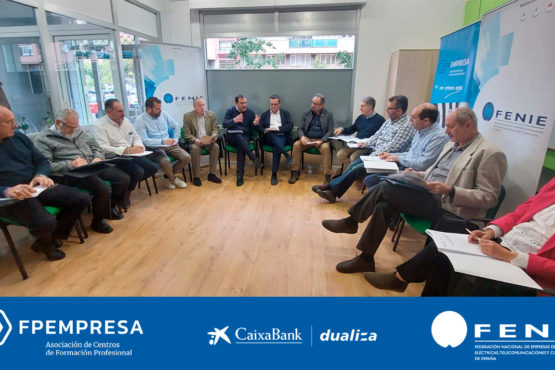
The Association of Vocational Training Centres FPEmpresa and FENIE had organised this Tuesday, 7 November, together with CaixaBank Dualiza, the conference “Present and future of Vocational Training in the installations sector” held at the headquarters of ASPRINELPA, the provincial association of employers of electrical and telecommunications installations in Palencia. This meeting, which stems from the collaboration agreement between FPEmpresa and FENIE signed in July 2023, is the first pilot test in Palencia and will later continue to expand the project throughout the rest of Spain.

Representing FPEmpresa was María Ángeles Bernal, the Association’s coordinating member in Castilla y León.

The aim of this meeting was to promote collaboration between vocational training centres and companies in the facilities sector in order to develop synergies between the business and training worlds.

Thus, the participants in the event included companies such as Electricidad Fergal SL, Electricidad Vicente SL and Elgosa Instalaciones y Montajes SL, among others, as well as the professional families of Electricity and Electronics of the Castile and Leon educational centres Centro Don Bosco, IES Santa María La Real and IES Trinidad Arroyo, a partner centre of FPEmpresa.

Programme

The event, inaugurated by Miguel Ángel Gómez, president of FENIE and ASPRINELPA, included various working groups where the participants, both representatives of installation companies and the education sector, raised different questions about the current context of student training and their employability in the sector.

After the networking session, activities were carried out with the aim of creating actions to improve the employability of young people in the installation sector. To this end, the advantages that VET can offer in installation companies were presented, as well as the opportunities that can be generated by educational centres to offer VET talent and boost the workforce in the installation sector.

To conclude the programme, those involved in the conference explained the opportunities that can be experienced if projects are carried out jointly, as well as the specific needs that companies of different sizes (between large and small companies) can demand. For this reason, visits by the entities to VET centres will be promoted so that students can get to know first-hand the job opportunities available to them once they have finished their studies, among other initiatives.

“We want to continue to develop activities of this kind together with FENIE, as they are key to continuing to focus on vocational training. It is important to keep up to date in all productive sectors, but especially in those that are constantly changing, such as the installation sector”, concluded María Ángeles Bernal.

  • 1
  • 2