The Association of Vocational Training Centres FPEmpresa, which currently represents more than 500 VET centres in Spain, and the Esprinet Group have renewed for the second consecutive year their collaboration agreement to carry out necessary actions in the field of VET.

This agreement was made for the first time in February 2022 and this year it returns with the aim of rewarding the best proposals for knowledge transfer in VET. In addition, among its objectives is the desire to promote female talent in training cycles where they have little visibility.

The president of FPEmpresa, Luis García Domínguez, states that “for the Association, renewing this collaboration agreement means maintaining our commitment that means that vocational training centres are allied with companies in our productive sectors. Likewise, this initiative allows us to continue our commitment to talent in all areas of VET expressed by women”.

Since FPEmpresa was created in 2012, it has been working to promote and foster vocational training through the exchange of experiences and good practices. In this way, the Association aims to become one of the agents that strengthen the VET system in the country.

“With the renewal of this agreement we reaffirm our commitment to promote key skills and abilities to train the professionals of the future. In particular, by giving visibility to female talent in those professional families of VET where its presence is testimonial”, says Javier Bilbao-Goyoaga, president of V-Valley Advanced Solutions (Spain & Portugal).

Following the renewal of this collaboration agreement, FPEmpresa and the Esprinet Group are launching entries for the 2nd edition of the Knowledge Transfer Awards in the field of VET. This call for entries is aimed at any public, subsidised or private educational centre associated with FPEmpresa. The registration period will be open from 13 February until 24 February and can be registered through this link.

FPEmpresa

FPEmpresa is a non-profit association that brings together public, private and subsidised Vocational Training Centres from all over Spain. In the same line, it contributes to create a network of centres able to share experiences, projects that want to develop and promote the Vocational Training System of this country.

FPEmpresa aims to give prominence to Vocational Training in the education system and to strengthen relations between the centres and their environment. The commitment between Vocational Training Centres and companies makes it possible to improve the educational offer for vocational training students and the pathways to integration into the labour market.

In 2019, the Ministry of Education and Vocational Training awarded the Plaque of Honour of the Civil Order of Alfonso X the Wise to the Association for promoting VET through collaboration between centres, the exchange of experiences and good practices.

Esprinet

Esprinet is an enabler of the technological ecosystem that, with a strong vocation for environmental and social sustainability, promotes technological democracy. With a

comprehensive offering of consulting services, IT security, services and products for sale or rental through an extensive network of professional resellers, Esprinet is the leading Group in Southern Europe (Italy, Spain and Portugal), the fourth largest in Europe and among the top ten worldwide.

The Association of Vocational Training Centres FPEmpresa attended the ceremony of the first STEAM Alliance Awards on 11th of february, coinciding with the commemoration of the International Day of Women and Girls in Science. Representing FPEmpresa was Tomás Alonso, vice-president of the Association.

The gala has been held in Castelló (Valencia), in collaboration with the Castelló City Council and was attended by the Minister of Education and Vocational Training, Pilar Alegría, the Minister of Science and Innovation, Diana Morant and the biotechnologist and astronaut, Sara García Alonso.

The STEAM Alliance, of which FPEmpresa is a member, is an educational project by the Ministry of Education and Vocational Training to value and promote the vocations of girls and young women in disciplines related to science, technology, engineering and mathematics. Thus, one of the fundamental objectives of the project is to reward the projects of the educational centres that strive to make female talent visible in the aforementioned fields.

“The Association belongs to this alliance in order to reduce the gender gap in STEAM education. All actions should be aimed at this reduction, starting from primary education to make the youngest girls aware that they can be capable of doing everything they set their minds to”, said Tomás Alonso, vice-president of FPEmpresa.

“From FPEmpresa, we congratulate all the VET centres that have been awarded in the categories of Intermediate and Higher Grade. It has been a pleasure to attend this ceremony to share this great experience, where the biotechnologist and astronaut, Sara García, also attended to emphasise that what she likes most is helping people”, added Alonso.

Bonanova Vocational Training Institute, the first winner of the STEAM Alliance

The awards are divided into five categories: Pre-school and Primary Education; Secondary Education and Baccalaureate; Intermediate Vocational Training; Advanced Vocational Training; and entities and organisations. The first prizes are endowed with 5,000 euros each, the second prizes with 3,000 euros and the third prizes with 2,000 euros. All the awards were presented by the Minister of Education and Vocational Training and the Minister of Science and Innovation.

Thus, the Bonanova Institute, a centre associated with the Association of Vocational Training Centres FPEmpresa, won the first prize in the category of Advanced Vocational Training for the project ‘Promotion of female talent and vocation for STEAM from vocational training in health and biosciences’.

The main objective of the project is to make the scientific-technological and research professions more visible to primary, secondary and high school students, focusing on girls and young women who are studying these subjects in order to bring them closer to the STEAM field.

To this end, the Bonanova Institute devises various activities that can be carried out jointly to promote STEAM studies among girls and young women, from the perspective of a vocational training centre specialising in the field of health and biosciences, showing not only the academic itineraries but also the associated future professions.

The Association of Vocational Training Centres FPEmpresa has surpassed this 16th February the figure of 500 associated centres from all over Spain. This figure is significant for the organisation, as it means that FPEmpresa’s objectives are being met every day.

Since the Association was set up in 2012, it has been committed to giving a leading role to VET in the education system and strengthening relations between the centres and their environment, helping to generate a greater public presence of these in society. Furthermore, the commitment between vocational training centres and companies is essential to improve the educational offer of training cycles and the pathways to integration into the labour market.

Having reached the figure of 500 associated centres, FPEmpresa continues to work to improve VET every day and to ensure its future growth, because the more centres we have, the more authority the voice of the Association will have.

FPEmpresa believes that all the players involved in VET should maintain the efforts made in recent years to raise the profile of VET and, above all, to invest in resources for it. VET centres should be a point of guidance, training and accompaniment towards the labour market.

VET as the first educational option, the greatest challenge for FPEmpresa

With the new VET Law, many of the main objectives have become a reality. A path has begun on which, if the resources invested are sustained, it could become a new VET comparable to its EU neighbours

Given the daily growth in the number of members, our network is committed to VET as the first educational option, as well as being sufficient, free, flexible and accessible to everyone. FPEmpresa also works to bring VET closer to companies and social agents. It is the future of citizens, but also the future of a healthy society and economy.

CaixaBank Dualiza and the various projects with which it promotes vocational training

Over the last 10 years, the Association has organised various projects related to vocational training thanks to the collaboration with its strategic ally, CaixaBank Dualiza. Both entities have worked together to launch noteworthy projects, such as the Convocatoria de Ayudas Dualiza, which to date has launched six different editions; and the Convocatoria de Orientación Activa, whose current edition is the fourth and whose aim is to recognise and support the guidance actions of educational centres towards VET and/or Dual VET.

In addition, every year FPEmpresa has received the support of CaixaBank Dualiza to organise the different VET Congresses in Spain, which aim to promote the VET of the future and share experiences and good practices among schools.

We would also like to thank the Group Esprinet for its cooperation, with which the collaboration agreement has been renewed to launch initiatives such as the VET Knowledge Transfer Award; Coca Cola for participating in ‘Gira Jóvenes’, its entrepreneurship and youth employability support project; the Orange Foundation, the ExE Foundation, CONIF, among others, to continue carrying out projects for and in favour of VET.

FPEmpresa is committed to Internationalisation

The Organisation is committed to Internationalisation in order to share its objectives and values with other European and international educational entities. For this reason, FPEmpresa is involved in international projects and associations, such as the Spanish Service for the Internationalisation of Education (SEPIE) and EfVET (European Forum of Technical and Vocational Education and Training), considered to be one of the most relevant international entities working to promote the quality of VET at European level.

FPEmpresa is also a member of another educational organisation of major international importance, WFCP (World Federation Of Colleges And Polytechnics). Belonging to these entities is not only beneficial for the Association, but also “for our associated centres, which allow them to have references and support in Europe or in other parts of the world”, says the president of FPEmpresa, Luis García Domínguez.

Tenth anniversary and 8th VET Congress

Another of the Association’s notable events was the holding of the VIII VET Congress, under the slogan ‘Building the VET centre of the future’, in Donostia-San Sebastián. More than 650 teachers gathered at this meeting to analyse the future of VET in the country, a record number of attendees for FPEmpresa. At the same time, the Association took the opportunity to celebrate its tenth anniversary, promoting vocational training centres with a future.

In 2010, the FPEmpresa project was presented as an innovation project under the motivation of 83 national VET centres. Two years later it would become the Association that seeks to represent the VET centres of Spain.

To watch the video about the 10th anniversary of FPEmpresa on YouTube, click here.

Finally, we would like to thank all the members who have participated throughout this time in the Boards of Directors and the current members of the Board of Directors, who every day work for a quality and innovative VET and for it to become the first educational option in the country.

The Association of Vocational Training Centres FPEmpresa has participated in the sixth PLA (Peer Learning Activity) of the European project PRALINE (Promoting Adult Learning in Networks), held on 30 and 31 January in La Rochelle (France). The meeting was organised by the Association Union Nationale Des Maisons Familiales Rurales d’Education Et (MFR).

The conference focused on the understanding of VET in France, digitalisation and the achievement of the Sustainable Development Goals in VET and Adult Education. During the presentation of these topics, the different speakers presented their possible solutions and alternatives through good practices in the country.

One of the main topics of the conference was La Rochelle, the French coastal city considered as a zero carbon territory. Joffrey Perrussel (Low Carbon Strategy Officer) and Julien Cluchague (Smart Campus Project Manager – Univeristy of La Rochelle) took part as guests.

Both Perrussel and Cluchague explained to the European partners that sustainable development has been a priority for La Rochelle for more than 40 years, thanks to the commitment of the population to fight climate change. Thus, one of the main objectives of the territory is to reach carbon neutrality by 2040 and to respect the objectives of the Paris Agreement.

MFR promotes new digital skills

Other topics discussed were the figure of the monitor by Sandrine Guibert (Pedagogical delegate FRMFR N-A – ANFRA) and Mathias Ledouce (Monitor – MFR La Garette); and the activity of the MFR Association. The Maisons familiales rurales (MFR) are vocational training centres that alternate study and work experience and are run by “families”.

These centres allow young people in rural areas to access education and acquire a professional qualification. Today, MRFs exist in more than 30 countries, mainly in Europe, Africa, Latin America and Asia.

After discussing improvements and new digital competences for teachers, as in previous ALMPs, PRALINE partners meet in groups to present their views and stimulate a debate to find new ideas among them.

At the end of the conference, the European partners have organised the dates for the next ALMPs: in May in Helsinki (Finland), organised by AMKE; in October in Croatia by Hrvatsko Andragosko Drustvo; and the last ALMP of the project will take place in December in the Netherlands by MBO Raad.

PRALINE is an Erasmus+ funded project that aims to strengthen and boost international networks of adult education providers already in operation by learning about good practice.

The Association of Vocational Training Centres FPEmpresa attended the meetings of the EfVET Executive Management held on 26th and 27th January at the Escuela Superior de Hostelería y Turismo in Madrid. Carlos de Olagüe, EfVET Coordinator for Spain and FPEmpresa Member for Madrid and International, also participated in the organisation of the meeting.

The agenda of the day covered discussions on various topics such as: policy, conference, membership action, finance and projects. However, one of the most prominent topics on the agenda was the preparation of the next European Congress on the island of Rhodes (Greece) from 26 until 28 October 2023. The Congress will include conferences, workshops, visits to VET centres and Market Place (networking meetings), although the theme of the event is not yet known.

The meeting on the 26th was followed by a visit to the facilities of the Escuela Superior de Hostelería y Turismo to learn about good VET practices in the centre.

The meeting on the 27th was followed by a visit to the facilities of the Escuela de la Vid, where José María Rodríguez, Director General of Secondary Education and Vocational Training of the Community of Madrid welcomed the participants, who came from 12 different countries.

Meetings to increase international relations

“The event has been a great opportunity to give visibility in Europe to the quality of vocational training in Spain. Both the Escuela Superior de Hostelería y Turismo and the Escuela del Vid have shown the methodologies and training techniques at the highest level. The Entrepreneurship Classroom of the School of Hospitality and Tourism, equipped with the latest technology, and the attention received by teachers and students have made possible the event with a great international impact,” said Carlos de Olagüe.

“Without a doubt, for FPEmpresa it has been an excellent opportunity to consolidate its international trajectory. In addition, this event was made possible thanks to the collaboration of the Directorate General for Secondary Education and Vocational Training and the teams and students of the Escuela Superior de Hostelería y Turismo de Madrid and the Escuela de la Vid”, concluded the EfVET coordinator for Spain.

Finally, the meeting discussed the work of the Thematic Themes (EfVET thematic teams), established in 2018 with the main objective of becoming a ‘Think Tank’, opinion leader and reference point for VET in a specific field. Also, to promote innovation and business opportunities among project members.

Currently, EfVET thematic teams are focusing on the areas of Entrepreneurship, Sustainability through VET, Tourism, VET 4.0, Internationalisation and Learning Mobility and Inclusive Vocational Excellence.

CaixaBank Dualiza and FPEmpresa have organised this Wednesday, 23rd November, the Dualiza Automotive Meeting at the IES Ana Luisa Benítez. This event, with the collaboration of the Sergio Alonso Foundation, was held with the aim of creating a meeting point where the centres that offer training courses in the professional family of Transport and Vehicle Maintenance can strengthen or establish new relationships with companies in the automotive sector within the framework of the new FP law.

Programme

The event was aimed at the educational centres where the TMV professional family is implemented, as well as business associations and companies in the automotive sector. The meeting began at 9am with a welcome from Javier Nuez Sáchez, director of IES Ana Luisa Benítez; and Eva Aguado, Territorial Coordinator of CaixaBank Dualiza.

This was followed by a presentation on ‘Vocational Training, a new scenario’ by Rosario Gañán Pérez, Director General of Vocational Training and Adult Education. Once finished, Manuel Socorro Valido, Dual VET prospector of the TMV professional family, started the presentation of the day. Nayra Moreno, director of the Sergio Alonso Foundation, spoke about ‘FP Plus automotive’ to highlight the importance of collaboration between the centre and the company.

Likewise, the CIFP Profesor Raúl Vázquez (Madrid) presented the good practices carried out in the Dual VET of the TMV family. Once again, Manuel Socorro spoke on the subject of the figure of the prospector in VET.

After the different interventions, there was a break to have breakfast and take advantage of the space for networking activities. To conclude the event, a round table was held to highlight the value of dual vocational training, under the title ‘Dual vocational training, the challenge’.

The 6th edition of the call for Ayudas Dualiza from CaixaBank Dualiza and the Association of Vocational Training Centres FPEmpresa has selected the 30 most innovative collaboration projects in the country promoted by 47 vocational training centres in collaboration with companies, which will receive a total of 402,759 euros for their development.

Most of these projects, a total of 19, have been presented by individual centres, while the other 11 have been selected in the network category, characterised by the fact that they are the result of the collaboration of several centres from different territories supporting a single idea.

These 30 projects will involve a total of 66 collaborating entities and 258 teachers through which the learning of 2,320 students will be improved.

Most of the selected schools are state-owned, almost 9 out of 10, while the rest are state-subsidised.

When selecting these 30 projects, the evaluation committee has taken into account that they should be innovative, encourage co-participation between centres, have a social impact, diversify the participating agents, establish coordination and communication mechanisms, contemplate sustainability to provide long-term results, be transferable, facilitate the communication of the achievements and seek to have an impact on the achievement of the Sustainable Development Goals.

Regarding this last point, it is worth noting that a majority of projects are committed to impacting on the ODS Quality education, followed by Industry, innovation and infrastructure and, in third place, decent work and economic growth.

As for the professional families in which these initiatives will be developed, the majority will be in Mechanical Manufacturing and IT and Communications, followed by Electricity and Electronics and Installation and Maintenance. However, the variety of proposals presented means that 17 of the 26 existing professional families will be represented.

The director of CaixaBank Dualiza, Paula San Luis, expressed her satisfaction that “more and more schools are becoming aware of and participating in the Dualiza Call and that this participation is diverse, both in terms of the content of the projects, the sectors chosen, as well as the ownership of the schools themselves”.

San Luis added that “this variety allows us to offer a real vision of what VET is, but also of what the Convocation is, where we are committed to collaboration between all the agents of Vocational Training with the aim of improving the learning and employability of students”.

For his part, the president of FPEmpresa, Luis García, added that “each of the selected projects is a way of sharing and learning together between companies and VET centres”.

The development of projects that can be implemented in real environments is once again the protagonist in this call, embodied in energy audits in educational centres, replicas of cybersecurity environments with attack and defence of infrastructures, construction of test benches, or applications to facilitate the circular economy through the use of car sharing.

The full list of selected projects is available here.

More than 650 teachers had analysed the future of VET and educational centres at the 8th VET Congress organised by the Association of Vocational Training Centres FPEmpresa and CaixaBank Dualiza, in collaboration with the Basque Government and the Orange Foundation.

Under the title “Building the VET centre of the future” and over two days, 26th and 27th of october, the Kursaal Conference Centre in Donostia-San Sebastián (Basque Country) hosted the debates on the challenges that schools will face in the medium term, what digital tools they will need and what role companies will play in relation to these same schools and students.

The President of FPEmpresa, Luis García Domínguez, gave a positive assessment of the results of the event and concluded that “working together to think and share what the vocational training centres of the future will be like by asking leading centres, companies, social agents and institutions has been the main objective of the 8th VET Congress. At FPEmpresa, we believe that VET centres need to share and learn in order to plan and design the future necessary for quality VET”.

The director of CaixaBank Dualiza, Paula San Luis, expressed her satisfaction with “the success of an event that has become a benchmark for VET professionals and because spaces like this serve to anticipate the challenges that we will have to face in the future and to work in advance on solutions”. San Luis added that “on this path, CaixaBank Dualiza will continue to support all the needs of both schools and teachers”.

A total of 30 speakers from different sectors, from academic to institutional, took part in the congress in order to highlight the value of the vocational training of the future and share experiences and good practices. Among the speakers were the Secretary General for Vocational Training, Clara Sanz; the Deputy Minister for Vocational Training of the Basque Government, Jorge Arévalo; the head of the Knowledge and Innovation Centre for Vocational Training at CaixaBank Dualiza, Mónica Moso; that of the Regional Secretary for Education and Vocational Training of the Valencia Region, Miguel Soler; and, finally, that of companies such as the Orange Foundation, by the Director of Sustainability of Orange and the Orange Foundation, Daniel Morales; Acciona, Volkswagen and IndesIA, among others.

The FPEmpresa Association also took the opportunity to celebrate its 10th anniversary, promoting vocational training centres with a future. Likewise, the FPEmpresa awards ceremony was held, as well as the awards of the 5th Call for Dualiza Grants.

Also, within the framework of this congress, several visits were made to VET centres in the Basque Country, such as TKNIKA, CIFP Usurbil LHII, CIFP Tolosaldea LHII, CIFP Easo Politeknikoa LHII, CIFP Don Bosco LHII and CIFP Bidasoa LHII.

The Congress has been broadcast live on the official YouTube channels of FPEmpresa and CaixaBank Dualiza and can be replayed in the following links:

Wednesday 26th October
Thursday 27th October

If you wish to consult the programme of the 8th VET Congress, click here.

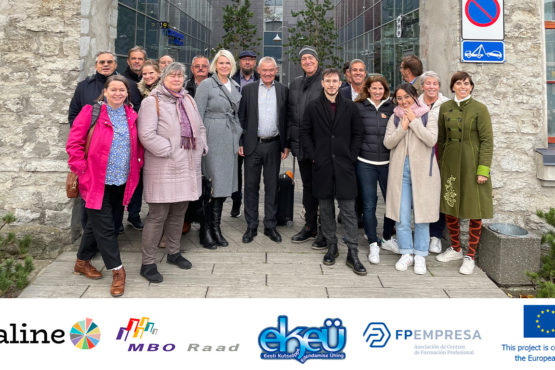
FPEmpresa has participated in the fifth PLA (Peer Learning Activity) of the European project PRALINE (Promoting Adult Learning in Networks) which was held on 6 and 7th of october in Tallinn (Estonia). For this occasion, the Estonian Association For Advancement Of Vocational Education has been the organization in charge of the conferences that have been carried out in the school Tallinna Teeninduskool and Harno.

The conference focused on digitalisation, automation and artificial intelligence and on how to improve the re-qualification of adults in the digital age. On these topics, the different speakers presented different proposals with examples of good practices in the country. In addition, the topic of digitalisation was addressed in general aspects of Estonia, which has a population of 1.3 million and is one of the most developed European countries in this area.

Among the participants who also shared their perspective on the Estonian education system and digital skills among adults were Merlin Tatrik, Head of Adult Education Policy at the Ministry of Education and Research, and Karin Künnapas, Head of Adult Education Policy at the Ministry of Education and Research; Karin Künnapas, Director of the company Kood/Jõhvi which offers an autonomous and self-taught education offer; Yngve Rosenblad, Chief Analyst at OSKA, Estonian Qualifications Authority; Keerli Požogina, Digital Competence Project Manager at Harno; and Jevgenia Smirnova, Head of the Labour Market Training Service at The Estonian Unemployment Insurance Fund.

The project partners also visited the e-Estonia Briefing Centre to learn about the latest digital skills that have been acquired by the country. Among them, having a virtual medical portal for the inhabitants, which can be accessed only with the ID card.

After having concluded the presentation of the days, as it was done in the four previous ALMPs, the PRALINE partners have explained their points of view in order to motivate a debate and thus find new ideas among them. In this way, a group dynamic is created on how the actions of the Estonian education system could be implemented in the other countries that are part of the European project.

Finally, the European partners will meet at the 6th ALMP in France next January and it will be organised by the association Union Nationale Des Maisons Familiales Rurales d’Education Et.

PRALINE is an Erasmus+ funded project that aims to strengthen and boost international networks of adult education providers already in operation by learning about good practices.

EFA La Malvesía, a centre associated to the Association of Vocational Training Centres FPEmpresa, has held an event to present the ‘New Agronet’ initiative to its educational community. It is an Erasmus + project, made up of teachers and students from France, Italy and Romania, to promote and consolidate the creation of new companies in the agri-food sector. Likewise, ‘New Agronet’ seeks to promote training in methodologies and new technologies among VET students; to increase the opportunities for students by helping them in their professional development; and to help create a more modern and professional environment in VET schools that encourages entrepreneurship. In this way, the project encourages the exchange of culture and knowledge and increases the motivation to work in the agricultural world.

Day

EFA La Malvesía was selected as the host entity for the international delegations to carry out this event. The ‘New Agronet’ programme was held at the end of September and proved to be a success for all participants. The day started with several participatory work sessions in the classroom. These sessions were in turn combined with visits to farms of interest. This helped students to refine and better define their agri-food business model proposals.

In addition, they visited the livestock farm ‘els Masets’, which became an example of the renovation of a family farm: from merely producing lamb meat, it has gone on to produce milk and quality dairy products, offering, among others, typical products of the area.

Finally, the attendees took advantage of the visit to the agro-ecological farm ‘Saifresc’ to learn about a production model that focuses on local, fresh and seasonal products.